News
Art vs. Stigma
Play audio version
DJP Fellows Advocate for Mental Health Awareness through Creative Expression
October 18, 2023
*This article covers the topic of suicide.
Disability Justice Project Fellows Esther Suubi and Kinanty Andini both advocate for the rights of persons with psychosocial disabilities through their art and filmmaking, working to create a world free from stigma and discrimination against people with psychosocial disabilities. The two were very active on social media in September, which was Suicide Prevention Month.
“I wanted to make something, to create something, that made people stop scrolling for a while,” says Andini, “so when they scroll through their Instagram feed, I hope that they will stop and see my art, and eventually read what’s on the art.”
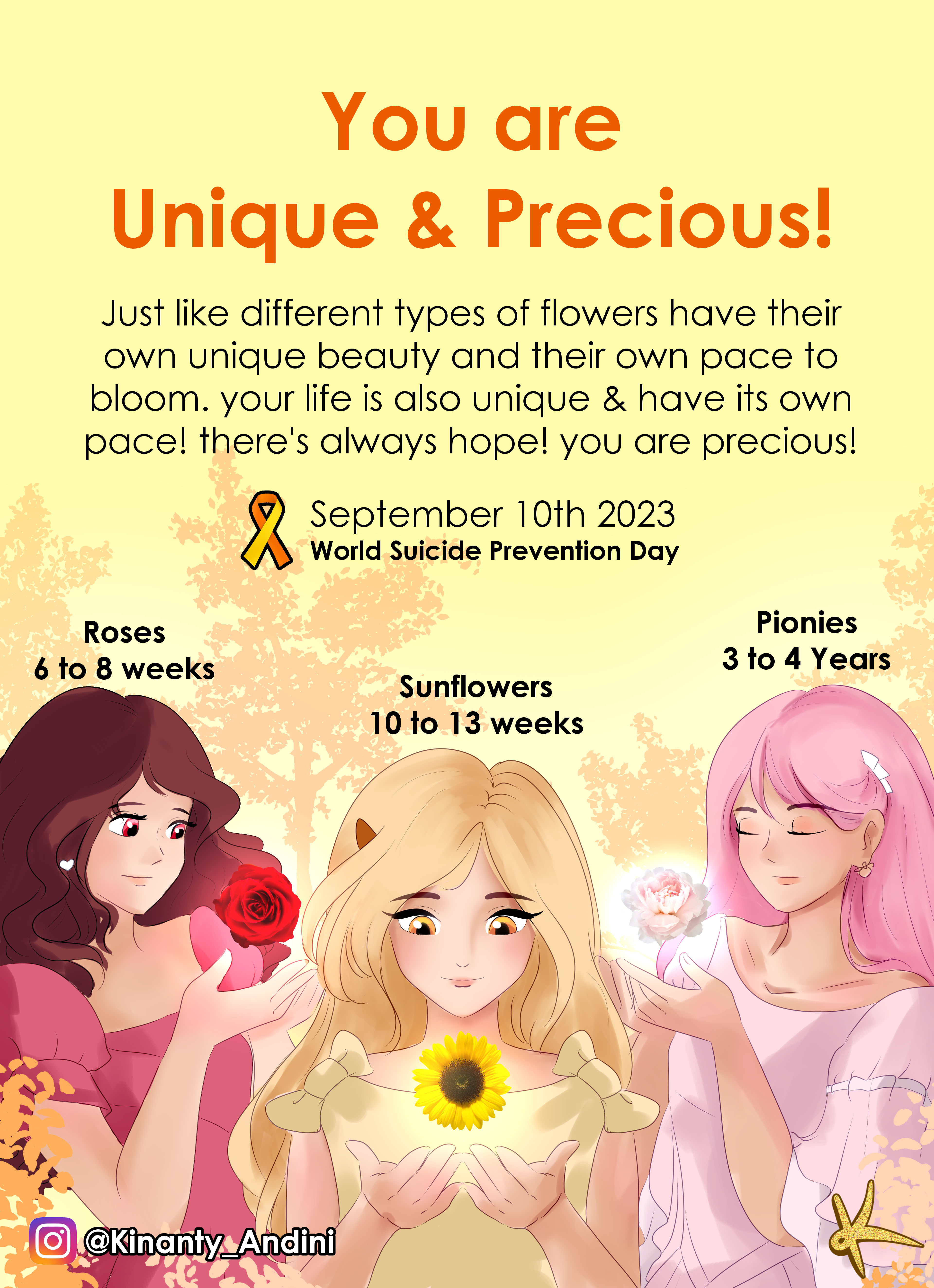
At the start of the month, Kinanty created a post for World Suicide Prevention Day depicting women holding flowers that represented different phases in a person’s life after a suicide attempt. She has received a lot of great feedback on it. The post, she states, was inspired by how she views happiness, and how she believes everyone’s journey is unique.
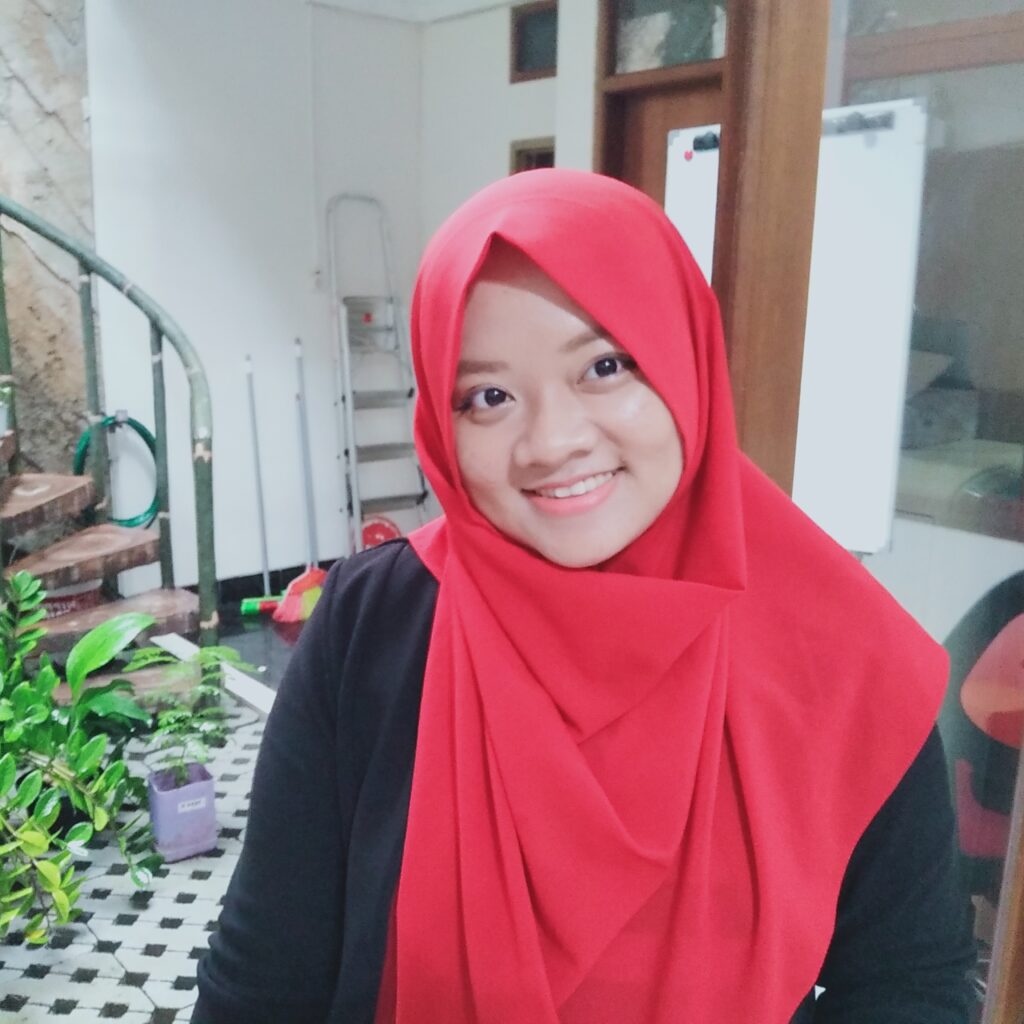
“I hope through my art that people who are having suicidal thoughts, they will know that they are actually very valuable,” says Andini. “I want people with suicidal thoughts to understand that, like different flowers, different flowers have their own pace to bloom. And happiness also has different paces to bloom. … If you look at other people, and go, ‘Oh, yes, … I see them enjoying their lives, why am I not feeling the same?,’ it’s not that you don’t have happiness at all. The time that happiness comes for people is different.”
For Andini, a graphic designer from Indonesia, advocacy work is about challenging negative assumptions about people with psychosocial disabilities. She uses her talents as a digital artist to connect with audiences and spread awareness. “People with psychosocial disabilities are among the most stigmatized out of all disabilities,” she says. “In society, and you know, even the people with psychosocial disabilities themselves often stigmatize themselves. In my country, they are consumed by stigma. They believe in stigma, so they stigmatize themselves.”
Andini’s advocacy work has led her to collaborate with several organizations in Indonesia looking to support persons with psychosocial disabilities. She has worked with the Indonesian Mental Health Association (IMHA), helping to create a short film titled “What’s Wrong with Mental Disability.” She also worked with the Disability Justice Project on illustrations for several articles and was featured in a video by the organization.
All of her art, according to Andini, stems from her school days, where she used her creativity as a coping mechanism to get through her isolation. “I’ve loved to draw since I was a toddler,” she says. “But my loneliness in high school that was caused by the stigmas my friends gave me is the reason that shaped my art.”
Andini recounts how she felt isolated because many of her peers refused to approach her or interact with her. “There were times when I had suicidal thoughts,” she says. “I wanted to end my life. … I was wondering and questioning myself over and over back then, you know, ‘What am I living for?’ That was a very hard time.”
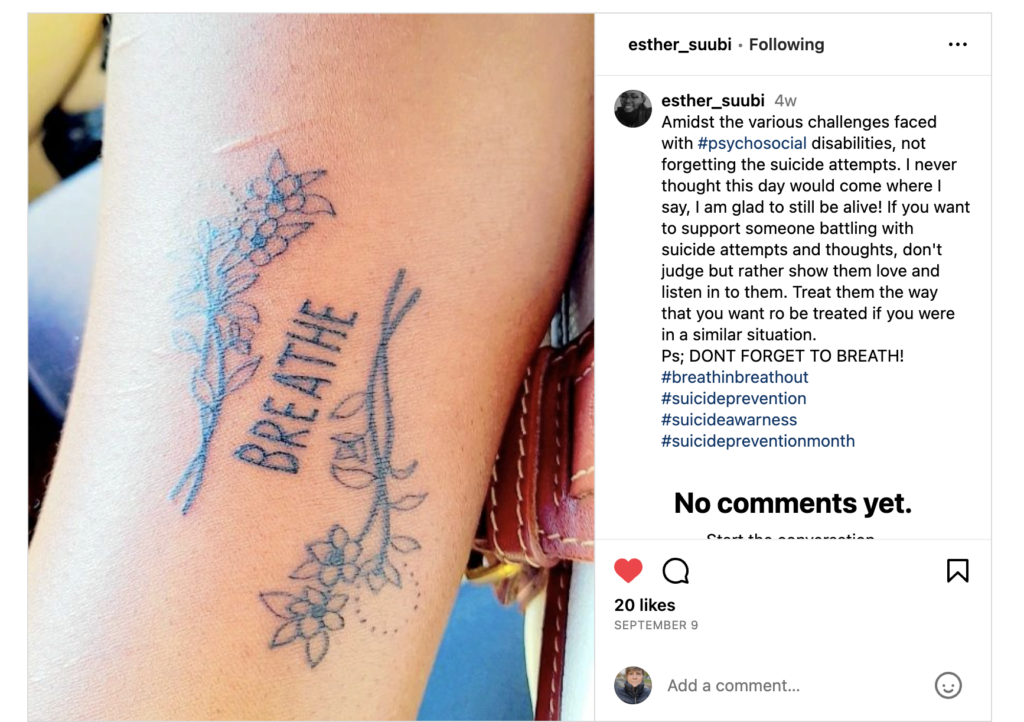
Suubi was also active on social media last month, using her platforms to spread awareness for Suicide Prevention Month. She posted an image of a tattoo she has of the word “breathe” enclosed by blooming flowers attached to their stems. She also posted another image of her tattoo that depicts the word “continue” with the “i” in the shape of a semicolon, representing the continuation of life after a suicide attempt. The posts were meant to remind viewers to reach out to loved ones who may be struggling with thoughts of suicide.
More than 700,000 people around the world die by suicide each year. Even more have made suicide attempts. According to the Australian Institute of Health and Welfare, people with psychosocial disabilities are nine times more likely to die by suicide than the general population.
“Why I still advocate and why I always share my story is because I’m a person who’s attempted suicide various times, in various ways,” says Suubi. “And for some reason, it never went through. I did the best I thought I could and it never went through. So, I’m like, ‘Okay, I guess there is a reason why I’m still alive. If all these attempts have failed, let me know how best I can support somebody else who can be going through a much worse situation.”
Suubi, a native of Uganda, has faced stigma surrounding her disability for most of her life. She was diagnosed with major depressive disorder, as well as bipolar disorder, as an adolescent. She remembers being shunned by classmates at school who refused to use the same facilities as her, and how she was told she had demons inside of her that were making her feel depressed.
Suubi soon found help through Triumph Uganda Mental Health Support and Recovery Program, where she now works as a peer educator. “What we do is work to ensure that we first raise awareness,” she says, “because there is no way we’re going to support a person with a [psychosocial] disability when they are not aware, when they do not know how best to support themselves.”
Part of the wisdom she gives to others revolves around one simple fact: you are not alone.
“When I joined Triumph … I got to learn that there were actually other people with the same disability. … You share and people are listening to you, and people are listening to your views and they respect your emotions, and there was no judgment.”
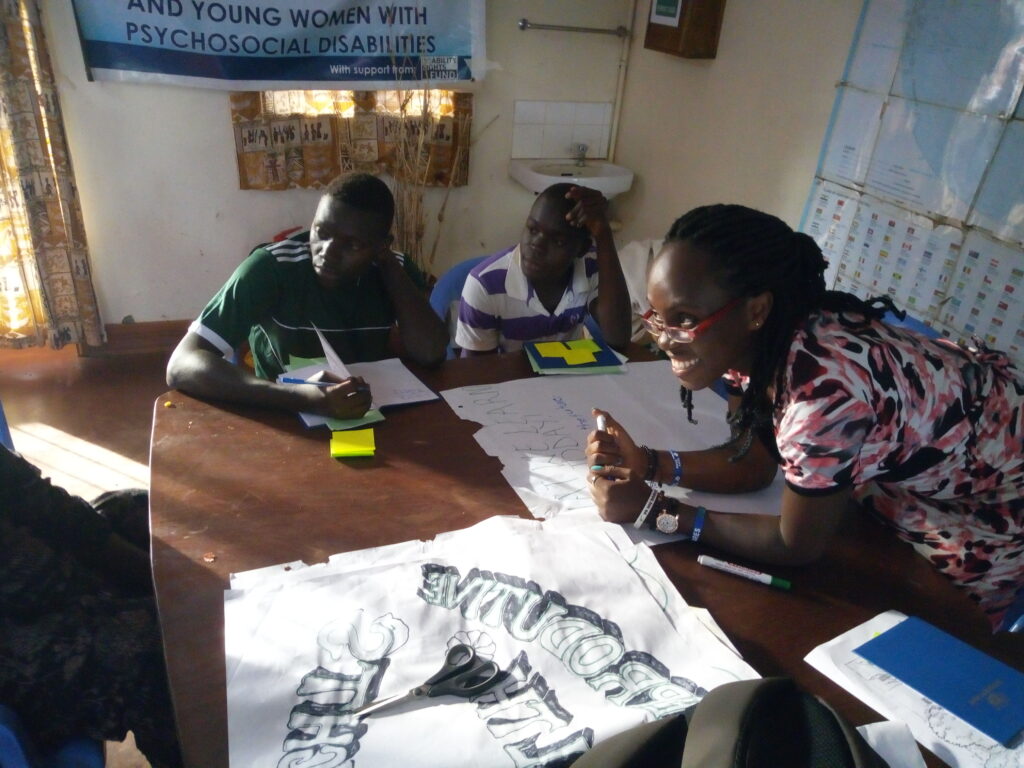
Suubi also has used her story to advocate for others living with psychosocial disabilities. She has been part of groups that work to help educate leaders about people with psychosocial disabilities. “I’ve really made sure that they will remember that there was an Esther in this training!” she says.
Both Andini and Suubi are doing their best to push back against stigmas surrounding psychosocial disabilities, especially as a means of preventing suicide. Andini hopes that people will begin to appreciate the struggles that people with psychosocial disabilities go through. “I hope that people will realize that mental health is really important, and I hope that many people will not be ashamed if they find out their friends or their family or maybe themselves have mental illness,” she says. “We must speak up and prove that the stigmas are wrong and stop agreeing with the stigmas. They have to speak up.”
For suicide prevention resources in the United States, go to SpeakingOfSuicide.com/resources. Go here for resources outside the U.S.
Maureen Lynch is a contributing writer at the DJP and a senior at Assumption University in Worcester, Massachusetts. She is majoring in communications and media, with a minor in writing. Lynch is the editor and chief of Assumption’s school newspaper, Le Provocateur, and the campus magazine, Valley Girl.
News From the Global Frontlines of Disability Justice
Reducing the Disability Tax
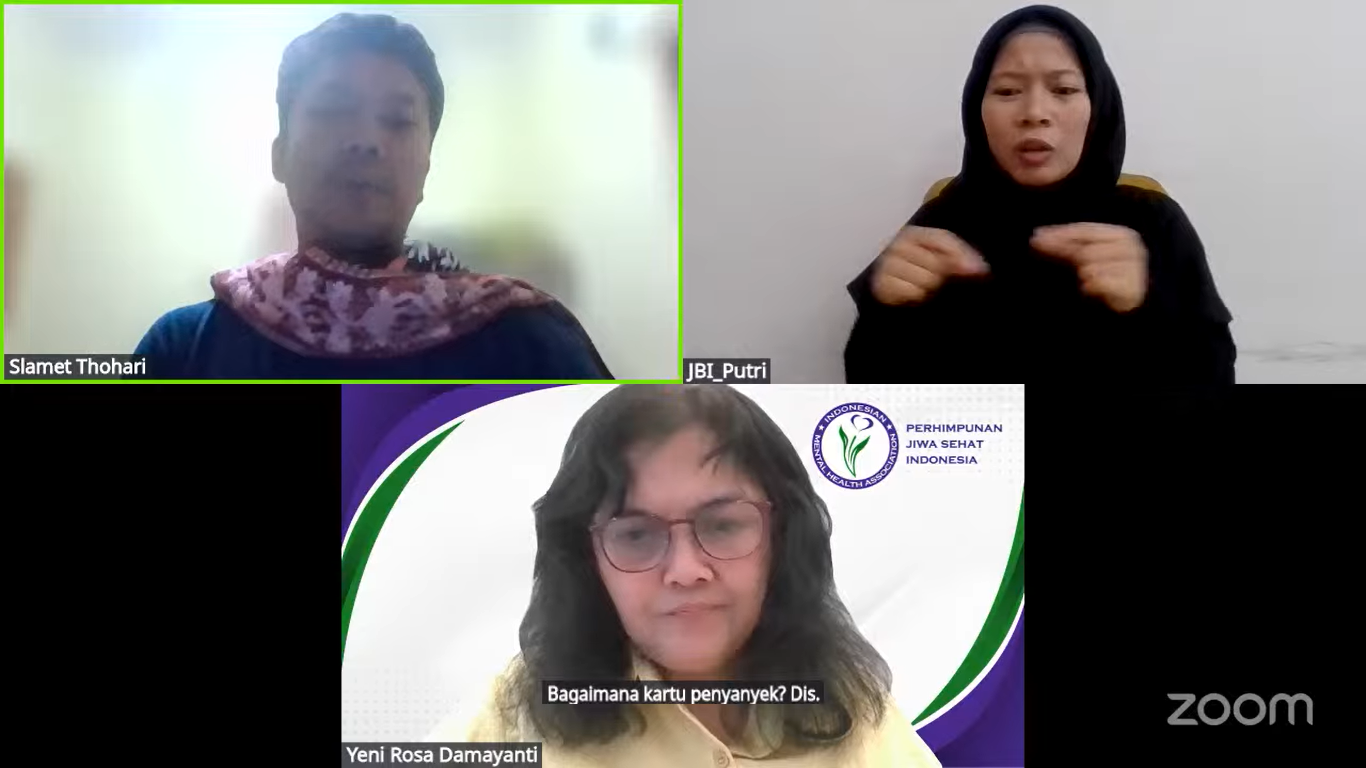
Indonesia has adopted a new regulation aimed at reducing the extra costs disabled people face, guaranteeing discounts across nine sectors, including health care, transportation and assistive devices. But disabled Indonesians say fees and administrative hurdles involved in obtaining the documents needed to access those rights could leave some people behind. As the government begins implementing the policy, advocates are calling for disability assessments to be free and accessible.
Joy As Resistance
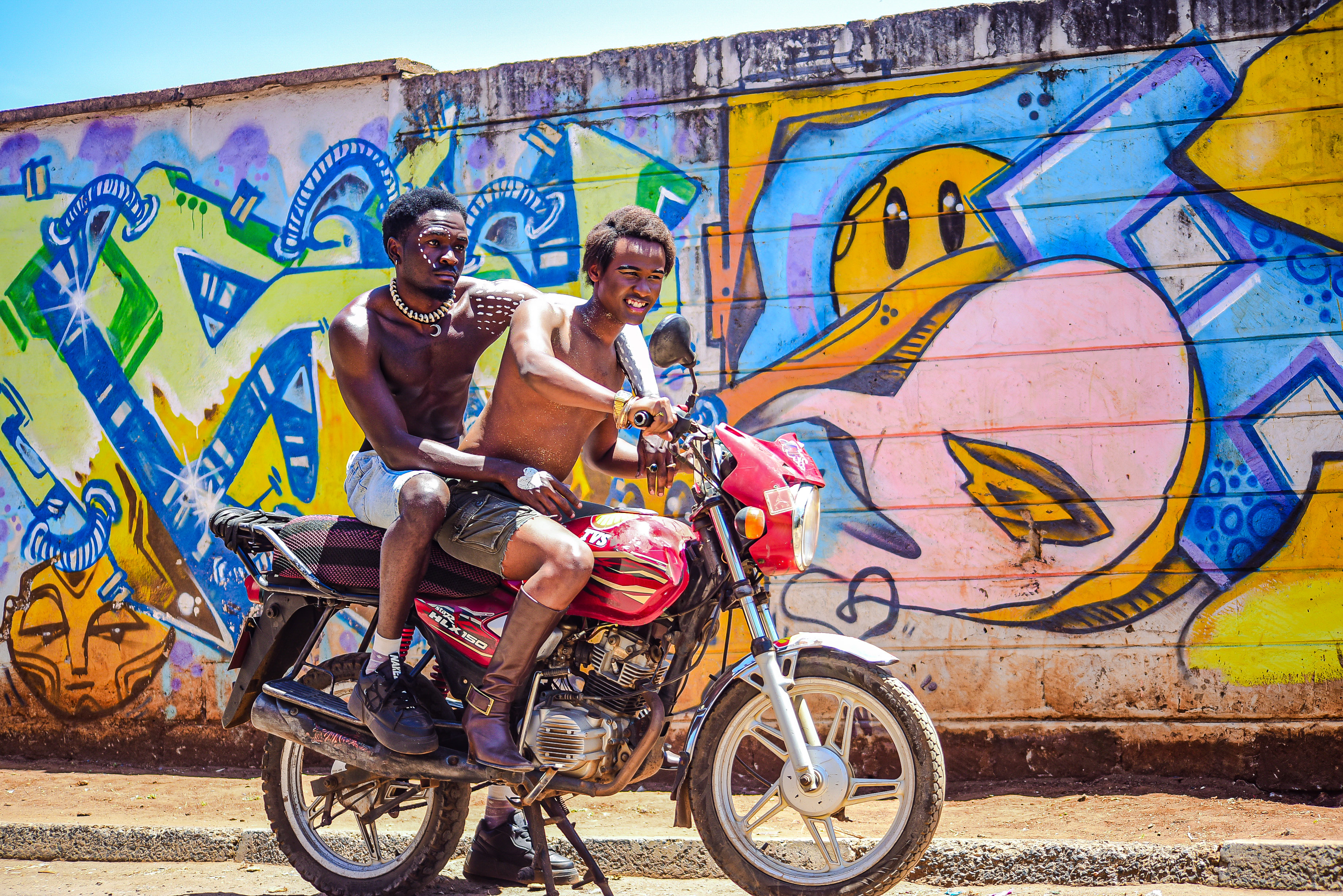
In Kenya, queer and disabled people are finding common ground around questions of identity, access, family, and belonging. Ahead of a Nairobi event exploring where disability and queerness intersect, organizers and participants talk about the communities they have found and the spaces they are trying to create. “Queer people and disabled people share way more than they think they do,” says one organizer. The event will use storytelling, art, performance, and what its organizers call “queer joy” to start a conversation they say is long overdue.
The Politics of Waiting, Wanting, and Hoping
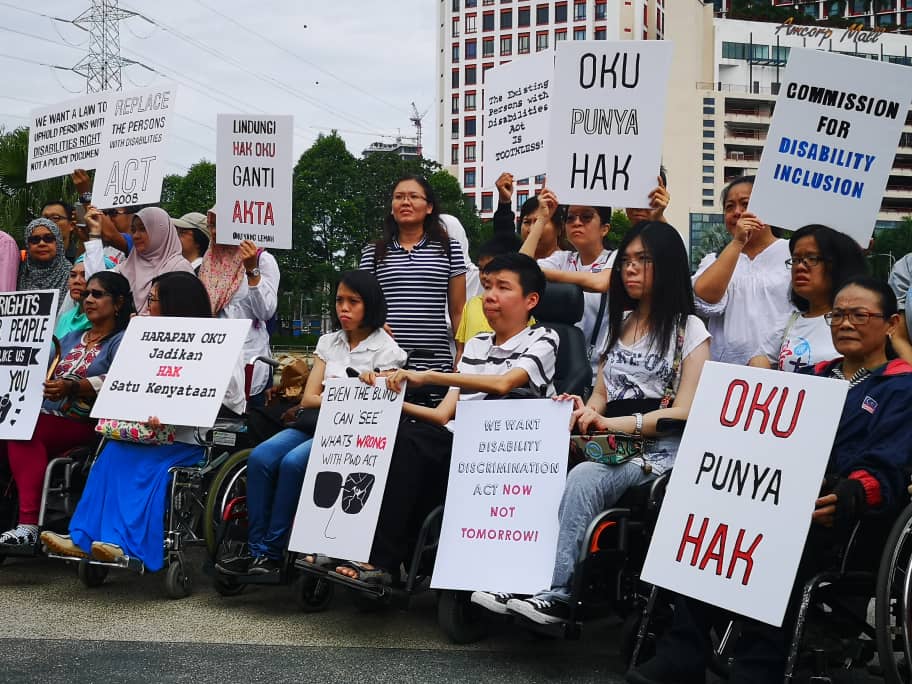
In Malaysia, disability exclusion is rarely one dramatic denial. More often, writes Beatrice Leong, it is “a series of ordinary delays” — inaccessible schools, symbolic consultations, policies without enforcement, and a system that asks disabled people to wait patiently for dignity and belonging. Blending personal reflection with political analysis, Leong examines what happens when inclusion is promised repeatedly, but justice never fully arrives.
Read more about The Politics of Waiting, Wanting, and Hoping

Beyond the ADA
The ADA’s influence extends far beyond the United States. It helped shape a growing international approach to disability rights that eventually contributed to the development of the CRPD. But global disability movements have also expanded on ideas that U.S. law has yet to fully embrace. “I think many U.S. disability rights activists were surprised to find out how much we could learn from the international community,” says Eric Rosenthal, founder and executive director of Disability Rights International.
Forgotten People
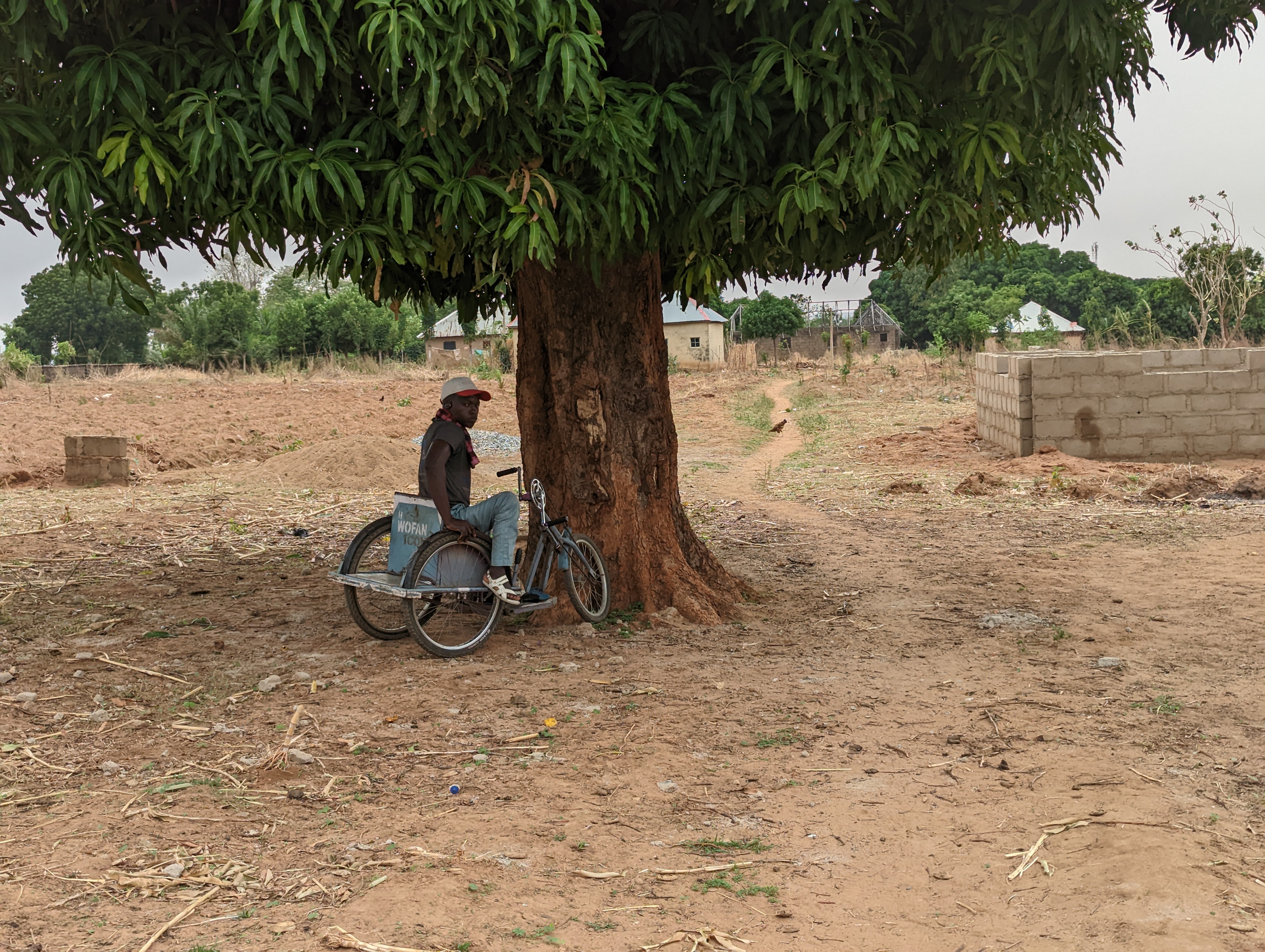
As Nigeria’s growing insecurity crisis spreads, disabled people face barriers that can make escaping violence far more difficult. Across the country, they describe inaccessible emergency warnings, challenges reaching safety, disrupted livelihoods, and limited access to assistance during times of crisis. Their stories reveal how conflict is experienced differently when mobility, communication, and support cannot be taken for granted and how disability is too often overlooked in emergency planning and response.

The Cost of Surviving
After years of failed treatments for complex PTSD, Marian Siljeholm followed an unlikely lead into the underground world of MDMA-assisted therapy. What began as a search for healing became a journey through the science of trauma, the politics of prohibition, and the hidden global network of people risking their freedom to help others reclaim their lives. Their stories would change her own. As Marian writes, “The next morning, I woke with a thought as real as the bed: This is the first day of my life.”