Film
Who’s Watching the Government?
Why Disabled-Led CRPD Monitoring Matters
The Disability Justice Project partnered with World Institute on Disability to train the inaugural cohort of Global Heumann Fellows in documentary storytelling as part of their year-long research projects. Read more about our partnership and the fellows here.
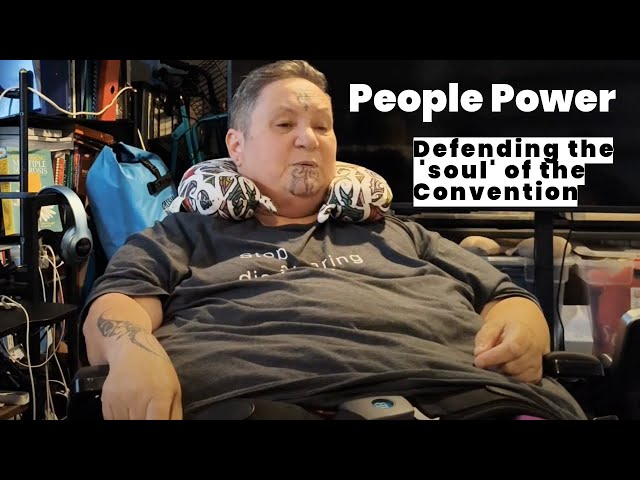
Across countries that have ratified the UN Convention on the Rights of Persons with Disabilities, disabled activists are working to fulfill what Article 33 calls for: independent, disabled-led monitoring to hold governments accountable for implementing the rights they agreed to. Featuring interviews from 11 countries across 4 continents, this documentary follows activists fighting that battle. “Article 33, it is the soul of the Convention,” says one. “If we don’t have monitoring mechanism … we’ll have word in the paper, nothing else.”
World Institute on Disability Global Heumann Fellow Robbie Francis Watene documents the risks and roadblocks disabled advocates face in advancing Article 33, from gatekeeping and underfunding to government pressure to stay silent. Yet, amid these challenges, the call remains strong: “We need a collective voice, strong voice.”
Access this film with audio descriptions.
Access this film with American Sign Language interpretation.

Filmmaker: Robbie Francis Watene
Dr Robbie Francis Watene is a scholar, leader, and human rights defender from Tāmaki Makaurau Auckland, Aotearoa New Zealand. With 35 years lived experience of disability, Watene has worked in the disability sector for over 15 years as a support worker, humanitarian documentarian, social entrepreneur, researcher, consultant, and advisor. She has experience working with disabled people in France, Bangladesh, India, Mexico, Colombia, and Ecuador and has spearheaded research on gender, war, and disability rights. Robbie is Disabled-Led Research Lead at the Donald Beasley Institute, where she oversees a variety of disability rights research projects and a team of disabled researchers. She is also co-founder and director of The Lucy Foundation, an international social enterprise that has developed the world’s first value chain of coffee that is entirely inclusive of disabled people - from the farmer in Mexico to the consumer in Aotearoa. Watene serves on various governance boards and is Mum to 3-year-old Mita, and 6-month-old Te Kawehaumārie (Ngāti Maru (Hauraki), Ngāpuhi, Ngāti Hine, Te Rarawa).
During her WID Fellowship, Robbie is investigating disabled person-led monitoring of disability rights implementation, with a focus on Article 33 of the United Nations Convention on the Rights of Persons with Disabilities (UNCRPD). With support from the DJP, she is documenting her efforts and creating a short film about her work.